DTF vs Screen Printing at 1, 10, 50, and 100 Shirts
DTF vs screen printing, priced like a side hustle: see take-home per shirt and per hour at orders of 1, 10, 50, and 100, plus the break-even point.
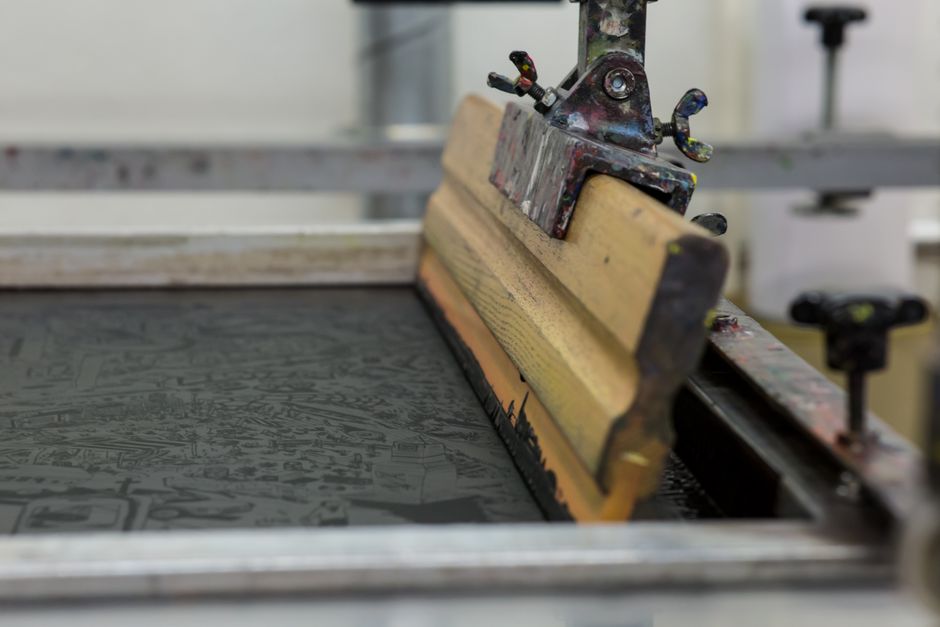
Most DTF vs screen printing comparisons are written for people who outsource. They grade hand feel, wash durability, color count, and fabric range, then send you off to request a fulfillment quote. If you are the fulfillment, pressing orders at a folding table between dinner and a day job, none of those grades answer your question. You are not shopping for prints. You are selling your evenings, and the only two metrics that matter are take-home per shirt and effective hourly rate.
Stay in the loop.
Get the latest posts and exclusive content delivered to your inbox.
Join 20 readers. No spam. Unsubscribe in one click, anytime.
Run both methods through that math at the order sizes side hustlers actually receive, 1, 10, 50, and 100 shirts, and the rivalry dissolves. DTF owns single custom pieces and short multi-color runs, because a screen setup cannot be spread across one shirt. Screen printing owns repeatable bulk, because its fixed setup hour amortizes toward zero. Price the labor instead of the ink and the crossover on hourly rate typically lands somewhere between roughly 20 and 50 one-color shirts. The two methods only look like competitors when you grade the print instead of the paycheck.
Why the Usual DTF vs Screen Printing Comparison Fails a Side Hustler
The comparison currently sitting near the top of the search results comes from a print-on-demand company. It sorts the categories correctly, DTF for small batches, screen printing for bulk, and then stops, because its business model is printing for you. Nothing in it tells you what either method pays per hour on the order sitting in your inbox tonight.
That gap matters because custom t-shirt business costs for a home operator are mostly labor bills, not equipment bills. Your evening contains a $25 one-off for a birthday gift and, next month, a 72-shirt reorder for a rec league. Those are two different businesses wearing the same Etsy shop, and a single-method recommendation serves exactly one of them.
So instead of another ink-and-feel roundup, this piece prices both methods honestly: blanks, transfers or ink, equipment amortization, setup labor, press time, cleanup, and a misprint allowance. Nothing gets to assume perfection, and your own time gets billed like the scarce resource it is.
The Cost Anatomy: Flat Per-Unit vs Amortizing Setup

The DTF vs screen printing cost per shirt question is really a geometry question about two different cost curves.
DTF is nearly flat. You buy transfers printed by a supplier, whose published transfer sheet pricing commonly sits in the low single digits per design, with quantity discounts that shave the price rather than collapse it. Shirt 1 and shirt 100 cost about the same to decorate: one blank, one transfer, a few minutes at the press. The curve is a horizontal line.
Screen printing amortizes. Before the first good shirt exists, you pay a fixed toll: coat and expose a screen, wash it out, tape it, register it, pull test prints, then reclaim and degrease everything afterward. Ink for a one-color print runs to pennies per shirt, so once the press is registered the marginal shirt is nearly free. The curve starts high and falls steeply.
Curve shape, not print quality, decides the winner at each order size. That is why the model below bills every line a side hustler actually experiences:
- The blank, both methods
- Per-transfer cost for DTF, or ink plus per-screen consumables for screen printing
- Equipment amortization, charged per shirt
- Setup and cleanup labor at its real clock time
- Press time per shirt
- An explicit misprint allowance, because neither method is perfect
The Model, With Every Assumption on the Table
Every number below is a model output, not a law of nature. Swap in your own inputs and rerun it; the structure is the deliverable. The baseline assumptions:
| Input | Assumption | Basis |
|---|---|---|
| Retail price per shirt | $25 | Midpoint of the $20 to $30 range most independent sellers charge, per a working custom shirt pricing guide |
| Blank shirt | $3 | Standard cotton blank at case pricing |
| DTF transfer, outsourced | $4 per sheet | Low single digits, mild quantity discounts |
| Plastisol ink, one color | ~$0.10 per shirt | A per-shirt screen printing calculator prices ink as a rounding error |
| Screen consumables | $2 per screen per job | Emulsion, tape, degreaser, reclaim chemistry |
| Heat press | ~$300, amortized $0.30 per shirt | Basic 15x15 clamshell over 1,000 shirts |
| Screen printing kit | ~$700, amortized $0.35 per shirt | 4-color 1-station starter kit over 2,000 shirts |
| DTF labor | 15 min setup + 3 min per shirt | Warmup, press, cold peel, second press |
| Screen labor | 75 min setup (one color, +20 min per extra color) + 1.5 min per shirt | Coating through reclaim |
| Misprint allowance | DTF 2% per shirt; screen 2 shirts per job plus 1% of the run | Asymmetric failure modes, below |
The 1.5-minute screen printing clip assumes a competent beginner on a manual press. Experienced printers outrun it comfortably; discussion of manual press output rates shows how wide that spread gets with skill and equipment. Note also that per-shirt amortization barely moves the ranking at any order size. The setup hour is what decides everything.
The Results at 1, 10, 50, and 100 Shirts
Here is the table no roundup publishes: take-home per shirt (revenue minus every cost above) and effective hourly rate (total take-home divided by total working minutes), for both methods at four order sizes.
| Shirts | DTF per shirt | DTF per hour | Screen per shirt | Screen per hour | Verdict |
|---|---|---|---|---|---|
| 1 | $17.55 | ~$58 | $13.50 | ~$11 | DTF, five times the hourly |
| 10 | $17.55 | ~$234 | $20.70 | ~$138 | DTF on hourly, screen on raw margin |
| 50 | $17.55 | ~$319 | $21.35 | ~$427 | Screen printing |
| 100 | $17.55 | ~$334 | $21.45 | ~$572 | Screen printing, and widening |
Three readings fall out of the table.
At one shirt, screen printing pays minimum wage. Roughly $11 an hour, and that assumes nothing goes wrong. Bill one to three hours of prep, exposure, and registration on a single multi-color piece and the rate goes negative. The DTF job, a bought transfer pressed at home, nets most of the $25 sale in well under half an hour. This bills production time only; add your customer-service minutes and both numbers drop, but nowhere near evenly.
Screen printing passes DTF on per-shirt margin by shirt three. Dilute the setup spoilage across just a few shirts and the margin flips early. Yet the hourly column does not flip until much later, because the setup hour has to be paid back before the cheap marginal shirts start compounding. Margin and hourly tell different stories, and hourly is the one that prices your evening.
How much per hour you make printing t-shirts at home is a batch-size question. The same DTF operation earns $58 an hour at singles pricing and $334 at hundreds, with no skill change at all.
The Break Even Order Size, and What Moves It

In this model, the hourly curves cross at about 27 one-color shirts. The defensible real-world band for a one-color, $25-shirt, $3-blank setup is roughly 20 to 50 shirts, and any article handing you a single number is overselling its precision.
Four things move the screen printing break even quantity:
- Your setup speed. A practiced printer who coats screens ahead of time and registers in 40 minutes pulls the crossover below 20. A first-timer taking two hours pushes it past 50.
- Color count. Every color adds a screen, roughly 20 minutes of setup, and registration care, plus flash-cure time between layers. At three colors my model pushes the crossover past 80, and a slow flash station pushes it further. Meanwhile DTF charges the same $4 for one color or fourteen.
- Transfer discounts. A supplier cutting $1 off each sheet moved my crossover only from 27 to 29, because a dollar per transfer is small next to the setup hour. Discounts nudge the crossover upward, gently.
- Art type. For photographic, full-color designs, screen printing effectively never catches up at side-hustle volumes, since its cost climbs with colors while DTF's does not.
Screen printing vs DTF for 50 shirts sits just past the crossover, where the model gives screen printing a clear hourly win, but a slow setup can drag it back toward a toss-up. If your numbers differ from mine, rerun them with a purpose-built break even calculator rather than trusting anyone's single figure, mine included.
Misprint Risk and the Time Nobody Counts
The two methods fail differently, and the model prices that asymmetry instead of assuming perfection.
Screen printing spoilage clusters in setup. Registration is off, a pinhole appears, the first pulls are test prints. That is the two-ruined-shirts-per-job allowance, plus one percent of the run for drift and flashes of human error. At 50 shirts it is a rounding error. At 1 shirt it is the whole story.
DTF errors are flat and per-shirt. Peeled a touch too warm, pressed 5 degrees off, placement drifted. Two percent of shirts, roughly, spread evenly. But at order size 1, one bad press burns $7 (a $3 blank plus a $4 transfer) out of a $17.55 job, 40 percent of the profit gone and the press time doubled. Two mistakes and you have donated the evening. Singles pricing needs cushion built in for exactly this reason.
The invisible time is on the screen side. Reclaiming emulsion, degreasing, drying screens for the next job, and cleaning squeegees never appear in any startup checklist, yet they run every single job. Track your real cost per screen for a month, consumables plus minutes, and you will likely find screen printing's true setup toll is heavier than the sticker math suggested. DTF's cleanup is wiping the platen.
How to Choose: Match the Method to Your Order Pattern
If your orders are mostly one-offs and short runs
Run a DTF transfer business on bought transfers. The only equipment is a heat press, consumables arrive ready to press, and any design, however many colors, costs the same. This is the cleanest heat press side hustle entry: at these margins a ~$300 press covers itself out of take-home in under two dozen shirts.
If you print the same art on repeat
Team reorders, annual events, club merch: this is screen printing's home turf. A kit in the $500 to $900 range can pay for itself on the first 100-shirt job if the alternative was turning the work down, and identical art makes every reorder faster as your setup time compounds into skill. Judged against DTF rather than against nothing, the kit only earns its keep on repeat bulk, which is exactly the order pattern you already have.
The hybrid stack most hustlers should actually build
Neither method wins everywhere, so the strongest position is both, staged by cash flow:
- Start with a heat press and outsourced transfers. Serve singles, samples, and multi-color short runs at $58-plus effective hourly rates.
- Add screens when repeat orders of 30 or more stack up, and only for designs that repeat. Screen printing startup kit cost is justified by reorder volume, not curiosity.
- Consider an in-house DTF printer last. A printer, powder shaker, and curing setup runs to several thousand dollars. If printing your own saves roughly $2 a sheet versus buying, payback takes on the order of 1,500 to 2,500 transfers. That rig only makes sense once you are buying transfers by the thousand, consistently, month after month.
Decision rule: bill every order for setup, press time, and misprints before you accept it. Singles and multi-color shorts go to DTF. Repeat bulk goes to screens. Everything else is a negotiation with the crossover band.
Grade take-home per shirt and per hour, not ink. Choose the method that pays your evenings properly at the order sizes your inbox actually delivers, and let the hand-feel debate stay on the design forums.
Stay in the loop.
Get the latest posts and exclusive content delivered to your inbox.
Join 20 readers. No spam. Unsubscribe in one click, anytime.
About the author
Hannah Cole
Senior Editor
Hannah writes practical guides on building income outside a day job, from selling online to beginner investing, with a focus on clear explanations and real benchmarks.
Related Posts
Best Online Course Platforms by Take-Home per Sale
The best online course platforms compared by take-home per sale, running a $49 and a $297 course through each fee stack to expose the real crossovers.
Things to Sell to Make Money Fast, Ranked by Real Hourly Pay
Things to sell to make money fast, ranked by real take-home per hour and days to first cash. See which items pay today and which build repeatable income.

What the Amazon Influencer Program Really Pays per Video
A reported $25,000 to $30,000 Amazon Influencer Program month sounds life-changing. We price the 500-video ramp behind it and compute the real hourly rate.